Showing posts with label Cooperstown. Show all posts

Tuesday, May 26, 2020

Missing Glimmerglass

"Even if I knew tomorrow the world would go to pieces, I would still plant my apple tree."
--attributed to Martin Luther

I first worked at the Glimmerglass Festival in the summer of 1999.  I had become disillusioned with the place I had worked for the previous two summers and was looking for a new summer home where the workers were valued as an asset, not used as cheap labor.  I found that at Glimmerglass, and have stayed there for every season since.

I would have started my 22nd season last week. 

My summer begins in December with hiring phone calls and seed orders. 

I've returned to the same company housing for most of my time at Glimmerglass, and have been lucky enough to garden there for nearly twice as long as I have had a home to garden the rest of the year.  I solidified my commitment to Glimmerglass the day that I planted asparagus there.

The paper tag identifies these as the seeds for Cooperstown.

And so, as I organize my seeds, place my orders, and plan my garden in the dead of winter, that planning always includes summer at Glimmerglass.  Springfield and Cooperstown have become a second home to me.  I have figuratively and literally put down roots there.

My ~10 week contract, starting right around our last frost date, favors plants that grow quickly from seed to maturity, and perennials that can take care of themselves for most of the year.  Below is a pot of a top-setting onion variety called "Egyptian walking onions" that I planted last fall.  They multiply by forming lots of small bulbs at the top of the greenery that drop down to the soil and "plant" themselves at a little distance from the mother plant.  Thus the "walking."  By bringing some of the top-sets indoors for the winter, I had a source of fresh scallions for cooking.  My plan was to then bring the pot to my summer housing (from here forward referred to as "the farmhouse") to plant now and let them multiply so I would have an onion supply that took care of itself and was ready to harvest from the day I arrived.

Egyptian walking onions, indoor onions about to leave the pot and joint their outdoor sblings.

Instead, I've planted the potted ones into the patch here at home.  I'll try a new batch next year to plant at the farmhouse.  I was happy for the winter supply of scallions, but it's clear that by spring the potted ones aren't as vigorous as those that stayed outdoors.  I am curious to see whether they "catch up."

My other experiment for farmhouse growing this year was with peas.  

Kevin Espiritu of Epic Gardening has grown climbing peas in a hanging basket to take advantage of his light situation--an area where there isn't enough light to grow veg at ground level,  but there is at eye level.

I borrowed his idea to take advantage of my seasonal situation.  I am home when it is time to plant peas, but at Glimmerglass when it is time to harvest and eat them.  I've tried starting seeds at home and transplanting them into the farmhouse garden, I've tried planting seed late at the farmhouse.  Neither was very successful.  So this year I planted at home, both in my garden and in a hanging basket for travel.  I've found an unexpected benefit...while something (probably deer) has eaten half of my garden pea plants, the basket is hanging out of reach and un-harmed.  Next spring I expect I'll be planting two baskets, one for my husband at home, and one to travel with me.

Snow peas and snap peas safe and sound above browsing height.

Like any good relationship, the plant exchange goes both ways.  I love having plants that carry memories of people and places dear to me.  I just transplanted asparagus from the bed my father planted 30 years ago to begin a patch at  home.  I've brought plants from home to Cooperstown, both to my housing and 
to the two gardens I was given permission to plant around the Glimmerglass costume shop.  I've also brought plants home to have a piece of Glimmerglass to enjoy for the rest of the year. 

Years ago we realized that there were iris leaves growing in a shade garden at the costume shop, but they had never flowered.  We transplanted them to the sunny side of the shop, and not only did they flower, but they have multiplied to the point where I had to thin them.  I spread the thinnings to other iris plantings around the Glimmerglass campus, and still had extras to give away and to bring home.  These pale purple iris bloom earlier than other colors.  They are always part of my first weeks at the Festival, but for now I am glad to enjoy them at home.

An iris transplated from the Glimmerglass costume shop to my home gardens in Wheatfield

Back in December, I prepared for Glimmerglass.  Even as a summer season looked less and less likely, I continued to plant and plan and nurture for an unsure future.  It's how I live in the world.  Using the present moment to plant and tend food and flowers for the (never guaranteed) future makes sense to me.

I miss my Glimmerglass family.  I miss the challenges of high quality professional work.  I miss working with my team, and spending days off with my closest friends.  In my loss, I also have opportunity.  I will finally see what blooms in my own garden in June.  I can experiment with container plantings that need too much watering to abandon for 10 weeks.  I spend time with my husband every single day.  

I can't visit my favorite summer places, but I can raise an Ommegang right here on my back porch, while I watch a father robin lead his fledgelings around the garden for the first time.


Next year in Coopertown, Glimmerglass family.


Tuesday, June 26, 2012

Guess the Fiber

Here I am at the farmhouse working at the festival.  I found a new "local" fiber I've never spun before.  It has spun up fairly soft and looks like it will bloom into a bit of a halo.  Any guesses as to what it is?  Please guess in the comments.

mystery fiber

Sunday, July 31, 2011

Asparagus part 2

Back in 2008 I blogged about planting my first asparagus plants at the farmhouse. I followed the instructions in my father's copy of "Sprockett's Victory Garden" but only 3 of the plants came up that first year. I had to fill in the trench when I left (around the end of July) even though only those 3 plants had sprouted.

When I got back the next summer, only 2 of the asparagus plants had survived. Incredibly disappointing, considering all the work it took three of us to dig a trench 10' long, 18" wide, and 12" deep. I'm not sure exactly what went wrong. I have a feeling that I planted too deep--6" of dirt over those original roots.

This summer was my first harvest from those 2 surviving asparagus plants. it was small.

asparagus
(cereal bowl included to show scale, and because it was morning)

So this summer I decided to try again, and had much better results. I planted a different variety, Jersey Giant in '08 and Martha Washington this time. I have no idea if that made a difference.

I was fairly certain that last time I had planted too deep, and filled in too much too soon. I think I followed the instructions in The Victory Garden book, but it was my dad's and I didn't have it with me, so I may also have remembered wrong. That time I planted 12" deep and initially refilled the trench with 6" of dirt. Since then I've checked more gardening books and websites and none of them say to go that deep. So this summer I followed the directions that came with my asparagus roots and re-dug most of the trench to 6" deep total, filling in with 3" of dirt until the shoots emerged.

That was successful. By the middle of July, every single root had produced a tiny fern, tall enough that I could return the last 3" of dirt to the trench, bringing it back to level with the rest of the garden.

full length of asparagus bed

The tall ferns at the far end of the photo are the 2 original Jersey Giants, the rest are the 10 Martha Washington asparagus I planted this year.

If all goes well I'll have all the asparagus I can eat in the spring of 2013.

Friday, June 24, 2011

Working at the Festival

This is a great overview of what we're doing at Glimmerglass at the moment. There's a quick shot of me cutting at my table, and of course lots of my co-workers are featured too. Only 8 days until the first opera opens--eeek!!!

Thursday, July 16, 2009

Sew A Mile In Our Shoes

La Traviata is in it's final orchestra dress rehearsal tonight. Glimmerglass has a tradition of putting full sets, costumes, and lights on stage much earlier in the process than most opera or theatre companies would. The advantage of this is that the designers can continue to refine their work to a much higher level and designers and director can better take inspiration from each other's work and react to it. From a costume point of view it also gives us even more time to custom fit the costumes we make for the singers.

The disadvantage to this schedule for us in the shop is that we have about half the "standard" amount of time from the point at which we do a first mock-up fitting to the point when we need to put a wearable costume on stage. This year we did that in about a week and a half instead of the customary four weeks. So we find ourselves needing to make design and fit changes to garments we're still scrambling to finish. The challenge is to continue to work to Glimmerglass's high standards while making these deadlines.

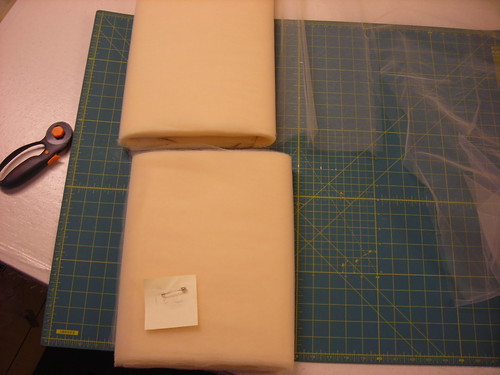
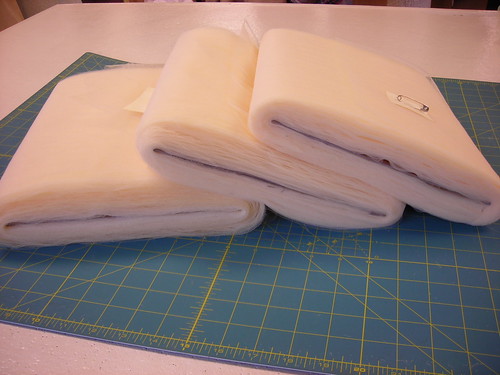
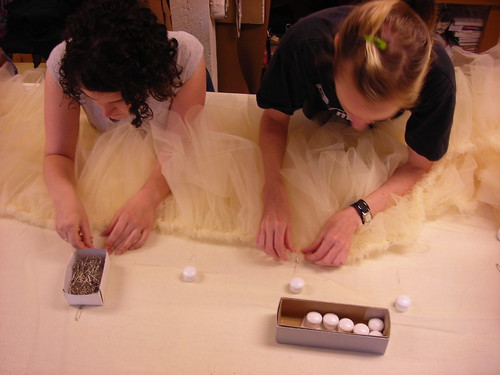
One of the most time consuming costume details my team has created this summer is a skirt made of layers and layers of tulle, covered in tiers of tulle ruffles. (If you've forgotten, tulle is a soft net, most available in nylon.)

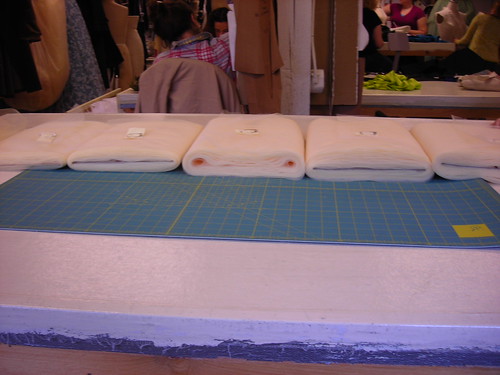
The numbers involved in this project (and remember they all translate to many hours of labor) are truly impressive. The inner layers which support the skirt include 8 layers of tulle, each of them 10 yards (30 feet) around. That took most of a 50 yard bolt of tulle. The ruffles are gathered onto a tulle base. In most fabrics a ruffle twice as long as the base to which it's sewn would look plenty full. Tulle has an amazing ability to gather, so a traditional 2:1 fullness looks less than skimpy. We ended up using a double layer of tulle for the ruffle, and gathering it 8:1 at the bottom, slightly less as the layers move up the skirt.


I cut the tiers by neatly wrapping the full yardage around a long cardboard card. Then I cut the correct tier depths through all the thicknesses with a rotary cutter. This probably saved hours of time over marking and cutting 13" from the bottom edge of 40 yards of net, then going back and doing it again for each of the rest of the 5 tiers.


The cardboard in the middle definitely made this process easier.


As mentioned, the tiers get fuller as they go down the skirt, which you can see by the varying thicknesses of the wound and cut net. The topmost ruffle is on the left, the bottom on the right.


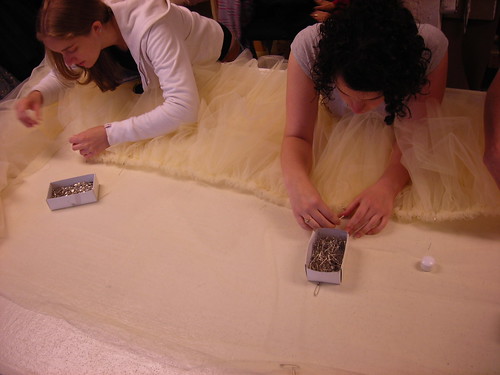
At least a half dozen costume technicians worked to gather, pin, and sew the tiers down to their base.


The finished skirt includes 220 yards of ruffle, all cut, gathered, and assembled in just a few days. That's on top of the 80 yards of tulle that hold the skirt out in its full shape. The hem underneath the bottom ruffle is held out to a circumference of over 3 yards by all of that tulle. I'm quite pleased with the final results, and my fantastic team!

Tuesday, July 15, 2008

Postcards From Cooperstown

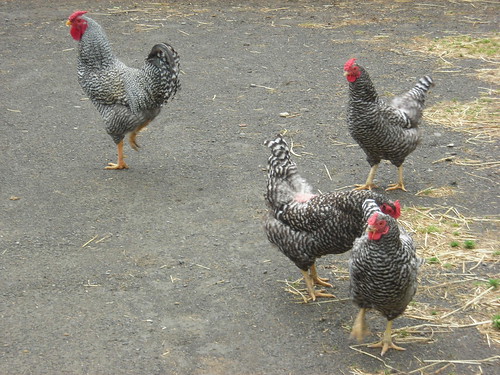
It's been a busy summer, more hectic than some, but there's still time to do a bit of site seeing around the Cooperstown area. Of course I adore the Farmer's Museum, where the chickens walk around the grounds with you.

Various flowers are blooming around the house. I think these are the flowering sweet peas that Lisa planted.
This was my tenth year at the Springfield 4th of July parade. This tractor is just slightly earlier than my favorite style of John Deere. I think this one is late 30's early 40's, and my favorite is mid to late 40's.
I didn't get a picture of the Opera's float, but there are several at the Opera blog entry for Independence Day. I did check the corn, which was indeed knee high by the fourth of July.
Our attempt at going to the Sterling Renaissance Festival (which I was last at 19 years ago) was horribly rained out, so the only photo I got was of Brittney filling her tank in full Elizabethan underwear.

Wednesday, July 02, 2008

Faith in the Trenches

In the past few years, I’ve gotten much more involved in gardening. I didn’t build or plant the garden beds here at the farmhouse. They have been passed down through various opera employees who have been housed here over the years, but I suspect started with an earlier more permanent resident. The garden improved greatly over the past 3 or 4 years after I started hoeing in the compost each May left from the previous summer’s compost pile. The first year the herb bed got compost, it went from only growing ten inch high basil to growing 2 foot high basil bushes. Let it never be said that compost doesn’t work!

As I get more involved in (and attached to) this garden, I get more ambitious about what I plant. I also get more optimistic about how long I think I’ll keep coming back to the Opera to reap the harvest of my previous year’s work. And of course, if I am going to expand the area and content of the garden, doing so with perennials means that I won’t have to keep planting all that space every year.

This year’s perennial expansion includes mint transplanted from Dad’s garden so I can have minty iced tea, rhubarb, and asparagus. All the mint that used to grow at the farmhouse has died out, so I got some of Dad’s unstoppable mint. We don’t even really know what kind it is (although it looks the most like pictures of spearmint) because it was already growing at my parents’ house when they moved in the year before I was born. I planted it after Memorial Day, and there’s already twice as much as I planted. The rhubarb is a hopeful investment for next year’s pies, but the asparagus is a real study in faith.

I tend to feel like most gardening is a study in faith. It’s not surprising at all that Jesus used planting and harvest in so many of his parables. It takes only a little faith to believe that when I plant a small plant, like tomato plants or herbs, it will grow to be a larger version of itself. It takes a tiny bit more faith to believe it will eventually bear fruit. For me, the really powerful experience is planting seeds, and then spending weeks carefully tending a patch of dirt. I’ve seen my lettuce seeds grow into a pretty impressive bed of salad for years now, but it still seems miraculous every time. It’s only faith in experience, in the words on the back of the seed packet, and in the previous experience of so many other gardeners, that keeps me coming back each morning to lovingly water a patch of dirt as if it was a bed of lettuce. And every spring, after a week or two of faithful, but emotionally illogical dirt watering, lettuce grows! I water even while I doubt. I question whether I planted it right this year, whether the seeds I bought are viable, whether I’ve planted at the right depth, provided the right amount of water, whether I’ve waited long enough to avoid frost. Even though I doubt, I continue to tend out of faith, and my faith is rewarded.

This spring, when I planted the asparagus, I set myself up for a much bigger test of my gardening faith. First off, I’m trusting that I will still be working at Glimmerglass in the summer of 2010 when I’ll get my first full harvest. Second, I’m trusting that planting dead stuff that looks like an octopus made out of dry sticks and raffia is going to actually result in asparagus, and wasn’t just a hoax perpetrated by the garden supply store. The best part is that both Rachel and Brittney joined in on my act of faith and helped dig THE TRENCH.


I am very proud of THE TRENCH. Every summer, I garden with only a few rudimentary tools, like a crappy old shovel and a nicer pitchfork. There are no rototillers or garden weasels. There isn’t even a wheel barrow to move the compost. The three of us used a hoe, a crappy shovel, and a pitchfork to dig THE TRENCH 10 feet long, 18 inches wide, and 12 inches deep, plus we had to loosen and de-rock an additional 6 inches of soil below that. Then, as it was getting dark, we went over to our neighbors, the dairy farmers, and politely asked for 3 buckets of old cow manure. We got to ride in a Dodge Dakota up to the hill where such stuff was piled and, with our shovels and rakes and implements of destruction, dig up our bucket fulls and ride back down to THE TRENCH. My intrepid helpers learned the hard way that when riding in the bed of an open truck with buckets of manure, one should ride forward of the buckets of manure to keep one’s eyes clear of debris.

Then began the layers. Commercial 10-10-10 fertilizer was spread in the bottom of THE TRENCH, then the manure, then 2" of dirt, then the dry spidery roots–10 of them at 1 foot intervals. Then another 6 inches of dirt. Then began the waiting. As the waiting got really long, my faith began to stretch and crack. After all, this was an involved process with lots of steps that could be screwed up. I could have buried the roots too deep, they might have sat dormant in the store for too long, they might be too close to the manure and get “burned.” I started looking for information on how long it should take for them to come up. Dad didn’t really remember, as his asparagus bed is at least 15 years old. “Sprocket’s Victory Garden” didn’t say. Most websites don’t say. I finally found one that said, “after several weeks,” and another that said “as the summer progresses.” I got antsy. That’s a whole lot of work, much of it offered freely by friends, that I’d hate to see result in nothing. I started getting worried that I wouldn’t see any asparagus before leaving at the end of July. I’m supposed to wait until it comes up before filling in THE TRENCH the rest of the way. I’d really like to fill it in the rest of the way, because I’m tired of having to weed the pile of dirt that’s waiting to go back into the THE TRENCH from whence it came.

Then yesterday morning, there it was.


One teeny tiny asparagus shoot. Asparagus in miniature. My shaky faith has been shored up. My doubt has been dispelled. If nothing else, asparagus #1, on the far left end, has come up. Now I’m waiting for the others, so I can finish the job.