Showing posts with label fiber. Show all posts

Saturday, February 16, 2013

A Good Day to Dye


I haven’t done any dyeing at home since before getting married. Once I was married, it seemed unfair to ask the other two members of the family not to eat any food in the kitchen all day because it would be contaminated by my dye.  There is an extra stove in my basement, waiting to become a dye stove, but so far no one with the know-how has had time to install a 220 line and hook it up.  Lately, I’ve gotten really antsy about waiting.

I finally realized that now that the boy has moved out, whenever my husband goes on a business trip, I’m home alone, which means I have time and opportunity to dye in the kitchen without poisoning anyone.  I’ve had a project in mind for a few years now.  The various fibers have been stored away waiting.

 Dyed wool, silk, and angora
From l to r:  Purple, navy, and green wool; purple, navy and green tussah silk; grey angora; and black wool.

The plan is to blend a heathered black.  I have over 2 pounds of wool, plus 8oz of silk and 4oz of satin angora.  What isn’t shown in the picture is that I dyed the majority of the fiber black (over a pound and a half).  The 3 other colors together make up about a third of the total weight.  I’m hoping to get a black with a dark rainbow that shines out here and there, kind of like an oil slick.

Some observations/stuff I learned while doing this:
  • ·         I need to dye more often!  Far too much of the process was unnecessarily nerve wracking because I couldn’t remember enough from the last times I’ve dyed, like how much fiber  each dye pot holds, or how quickly the dye starts absorbing.
  • ·         Angora doesn’t take dye very well.  As I watched the angora resist dye, I realized that I must have already read or seen that somewhere before.  I used just as much black dye on the angora as everything else, and heated it for just as long, but it’s hardly grey.  I’m not worried about this in the final project, as it’s such a small portion of the overall weight I doubt it will have any negative effect on the color.  I’m hoping it’s just enough angora to add softness and a slight halo to the finished yarn.
  • ·         Good record keeping is everything it’s cracked up to be.  Even thought I haven’t dyed in ages, it was easy to figure out my color formulas based on my samples and records from previous projects.
  • ·         It pays to clean the kitchen, weigh the fibers, and do the math the night before.  Again, because I don’t do this often enough, I had to spend considerable time reviewing Color in Spinning to find the formulas for calculating how much of each assist to use.  Doing the math the night before allowed me to use my dye time much more efficiently that day.
  • ·         Wet fiber won’t dry while clumped together.  Enough said.
  • ·         I need a giant salad spinner to whip the water out of my dyed fiber using centrifugal force.
  • ·         I want more time in my life to dye, card, and spin.
  • ·         I really like green and purple.

Wool, Angora, and Silk, ready to dye
from l to r:  wool, satin angora, and silk, all pre-soaking in synthropol in preparation for dyeing.

Saturday, January 05, 2013

The Gift That Keeps on Giving


Not that I would ever be as crass as to post about presents after Christmas, but I would like to share just one thing.  This is somehow my own fault, as my list could be interpreted as to include this item, although only a genii would interpret it that way.  It’s also my fault for having a little brother.

 Garden gnome riding a rabbit
  
Yes, it’s a garden gnome riding on a rabbit.  And yes, I immediately installed it in the garden, even though I’ve been taking gnomes out of my summer shade garden as quickly as Jacqui can put them in.  I do think this wonderful ridiculous item looks quite fetching in the snow.  Apparently it’s part of a whole series of gnomes riding different creatures. 

 Garden gnome riding a rabbit
 
My brother has been living overseas for the past few years, so we tend to exchange (and wrap) our gifts through Amazon.  So far this has been small rectangular items like cds and dvds, which Amazon wraps in dark blue paper with a grey grosgrain ribbon wrapped around it.  The gnome came in a rather large box.  Instead of being wrapped, the whole box was in a big blue sack with green grosgrain drawstrings.  Not one to turn my nose up at useful stuff, I put it right to work as a fantastic wool bag.

  Grey wool drum carded 
together

I had bought two different natural grey wool rovings this summer with the intention of making a Central Park Hoodie.   

 (Romney?) Roving from Dutchayr Fibers

 Shetland roving from Shadeyside Fibers

Happily, I had some project time over my Christmas break, so I spent some of it blending the two wools together with my drum carder.  The drum carder is still very new to me and I’ve had trouble finding much information or advice on using one.  I have The Ashford Book of Carding, which doesn’t say a whole lot about drum carding before wandering off to color blending.  I went through my spinning books, from Lee Raven’s introductory Hands on Spinning to Alden Amos’ Big Book of Handspinning.  They have almost nothing specific to the drum carder.  So far drum carding has been largely a matter of trial and error.  Each time I use it, I make a new discovery.  Last time it was that most of what ends up on the small drum is short and undesirable fiber.  I was really excited about that one.  This time it was that carding oil, besides making carding easier and preventing fiber breakage, actually allowed me to make larger batts than without the oil—not hugely larger, but I did get noticeably more nicely carded wool onto the drum with oil than without.  My other realization was that I’m a dummy for trying to push how big a batt I can make before doffing it.  If I get greedy, the outer layer of the big batt isn’t very well carded.  If I doff the batts when they’re still a little thinner, they’re much nicer and more thoroughly carded.  I shouldn’t be so surprised; I discovered exactly the same thing with hand cards years ago.  So far, I’ve only blended on the drum carder.  I have a longer term project in mind which will involve dying and carding the fleece I bought 2 falls ago, and then blending it with some other nice things, all using the drum carder, but I’m still waiting for my dye stove to get hooked up in the basement.  Maybe by next Christmas break.

Tuesday, June 26, 2012

Guess the Fiber

Here I am at the farmhouse working at the festival.  I found a new "local" fiber I've never spun before.  It has spun up fairly soft and looks like it will bloom into a bit of a halo.  Any guesses as to what it is?  Please guess in the comments.

mystery fiber

Saturday, December 18, 2010

New Drum Carder!!!!!!!

Recently my friend Mary Ellen made reference to the happiness that can come from purchasing something new. Not just anything, but think about when you were a kid and spent months saving up allowance for something really special. I remember spending about a year saving up for my first stereo, and I loved it from the first day I had it. It seems like something changed, either from childhood to adult life, or in our culture since then. Now it's more likely that Ill spending months paying off a previous purchase, instead of saving up for the future. The last thing I saved up for was my spinning wheel about ten years ago.

Unlike many spinner I only own one wheel. I do have some extra flyers, 3 sets of hand cards, and 2 sets of combs, but they were all acquired over 5 years ago, and one of the sets of carders was used and practically free.

So when a very slightly used drum carder came up for sale by a member of my guild, I decided that now might just be the time for a new equipment purchase. I didn't save up, but I'm counting this as my up-coming Christmas money, well spent. After spending about 3 years hand carding wool for my purple sweater set, I think it's high time I treat myself to this lovely time saver.

Behold, the Fancy Kitty Kitten Drum Carder:

new fancy kitty kitten drum carder!!!!

The lovely woman who sold it to me decided that her life was too short for fiber prep, and she could happily spin prepared rovings from now on. I don't blame her--our guild has several very talented dyers who sell their work. I've decided that life is too short for hand carding. Either way, she was so over fiber prep that she gave me a bag of fibers she had planned to blend on the carder, and a partially finished batt.

The thing is that I like dying, and while multicolored rovings look great, and make for very attractive multicolored yarns, they necessitate very simple knitting. What I've discovered about myself is that the knitting is my primary goal, and I prefer to work with simpler yarns that allow for more complex knitting. I've made the mistake of trying to do colorwork or cables with visually complex yarn, and it just becomes a muddy indistinct lump that I spent a lot of hours on. So for me a drum carder makes it possible to buy a fleece and dye sections into related colors I can then card together for more subtle heathers that will still allow cables or lace to dominate visually. Or I can dye for individual skeins of closely related solids for a fair isle.

Of course this will lead to buying fleeces. But it saves me the cost of shipping and processing, which is what I used to do. And did I mention it saves me the time of hand carding to blend colors? Life is too short for hand carding.

So I ran home, put the drum carder on the kitchen table, cranked up my audio book, and started cranking fiber through.

feeding in the wool

I quickly discovered that I had questions, and that none of my spinning books had answers. How do I only own spinning books that refuse to address the drum carder beyond acknowledging it's existence?!?!

For instance, as I worked, there was a lot of fiber staying on the licker-in. I kept trying to remove it and feed it back through, but it kept ending up there. Then I realized that what was on the licker-in looked like this:
nep and short crap from the licker-in

Could it be that unlike hand cards, drum carders separate out the neps and short crap? I checked the internet. The internet had way too much information, but it seemed to confirm that yes, it did separate this stuff out on purpose! So I stopped trying to undo the help the Kitten was offering, and put that crap aside.
I already know from my fleece study experience that I prefer to flick card first, removing as much of the short and tangled wool as I can, before either carding or combing. It seems the same will be wise with the drum carder, and produce the kind of smooth batts I prefer to spin.

Eventually, I made this:

pulling a roving off a drum carder

and this:

pink batt

with the fibers the original owner was so kind to pass along. I was a bit dissatisfied with dizzing the blue roving off the drum. Too much fiber was left behind, so I will probably tear the pink batt into strips or into a roving to spin. It was way too time consuming to diz off some of the roving, and then still have to remove a small thin batt of what was left. It will be much faster to remove everything together as a batt and then deal with it from there.

At this point I got excited and went off on my own. I love to spin cotton, and a little while ago a friend gave me this:

free 14 pound bale of cotton

a bale of cotton. That puppy must weight 20 pounds. I was going to hand card punis from it, but that was going to take the rest of my life. The carding cloth on this Kitten looks just as fine as on my cotton hand cards, and if it all goes to hell I might waste, what, one or two ounces out of 20 pounds?

I didn't really find any guidance on doing this, but I was also too cocky to look. In the name of science, I experimented.

First I fed in the cotton in the usual way:

too much cotton on the licker-in

and about half of it stayed on the licker-in. Not good. So I added it the other way I'd been shown, directly onto the drum as I cranked.

feeding the cotton directly onto the drum

This was much more successful. 3 or 4 times the amount added in only left this:

much less cotton on the licker-in

on the licker-in.

I removed the batt, split it, and recarded in thin layers a few times, just like with the first 2 batts.

Then I had to decide what form the carded cotton should finally take. A batt seemed too big and loose, and like it might fall apart before it ever got to the wheel, so I tried 2 things.

I dizzed off a roving which was generally frustrating. So then I tried rolling the batt around a knitting needle to make a puni, just like I would have done with hand cards.

rolling the cotton off as a puni

I got 4 fairly thick punis from one batt:

4 cotton punis

as opposed to this mess of roving from the other:

cotton pulled off as a roving

I got in a little time on the wheel this morning, and as I suspected the punis are quite nice to spin from, but the roving is a bitch. If I wasn't an experienced cotton spinner I would have thrown the roving out the window! At this point I'll still spin it up just to see what I get, and keep examining how the 2 preparations work. I may try making the punis just a little smaller to compare, but by and large this will now be my go-to for prepping that bale of cotton.

So thanks very much for the drum carder! Now I need more time to knit and spin. I don't suppose I can do that this week instead of putting up the tree, making cookies, and cooking Christmas dinner for both sets of parents? I thought not.


Monday, August 23, 2010

Spinners guild reveals reasons ‘why ’

This was a really nice article published in the local "Bee." Unlike the Buffalo News reporter who interviewed many of the same people and got much of the information wrong, Naomi Spencer was really lovely and attentive, and wrote an accurate, interesting, and articulate article about our local spinning guild.

Spinners guild reveals reasons ‘why ’

Wednesday, August 11, 2010

Knitting and Beer, What Could Be Better?

I was recently asked, by a very young reporter, how long it takes to make something if you start by spinning the yarn. There are of course 2 answers to the question. There is the answer in hours, and there is the answer in years. Interestingly, these 2 answers do not work out to the same amount of time.

Case in point: I have finally finished my purple sweater set. Upon our third summer together, my friend Rachel looked at me working at my spinning wheel and said "Isn't that the yarn you've been spinning the entire time I've known you?" Lucky for her, I wasn't at a good point to let go
and throw my niddy noddy at her.

finished sweater set!

How many hours did this set take? Well, I started with white roving: 2 pounds of wool and 9 ounces of silk. I spent a day dying the wool in 4 separate shades of purple and painting the silk
in the 4 shades sequentially. The most time consuming part was that I then hand carded the 4 shades of wool into heathered rolags before spinning them. The combination of carding and spinning may have taken as much as 200 hours. It felt like longer. Then I knit 2 sweaters, that probably took about 100 hours (these are hugely estimated numbers). I think I spent about 10 hours making the lovely dorset buttons. So all told that would be 310 hours and a day.

dorset button

How many years did this sweater set take? Well, as best as I can remember I started in the summer of 2002 or 2003 when I bought the wool in Delphi NY. I finished this past June. That's 7 or 8 years to complete a sweater set. Over those years I had 3 different "school year" jobs. We went through 4 costume directors at the Opera. I lived in 4 different cities/towns, had 4 apartments, got married, and bought a house. That's way more than 310 hours and a day.

After finishing in June, I figured I would put the set away until December, but we had such a weird summer that I wore it on July 1st and was quite happy to have it. Since that day it's been over 80 every day.

There have, of course been other projects during that time. In fact, anything on this blog or on
my Ravelry page was made during that time. Plus there's all the other hobbies.

I love when my very different interests in some way intersect, overlap, or inform each other. Like how the garden feeds the rabbits and the rabbits supply the compost that feeds the garden. And the spent grains from brewing feed the compost feeds the hop vine makes beer. Or when Queen sings about relativistic time dilation. Or how when a math/science student takes costume construction I can point out that the balance points on a sleeve head are the 2 points on the curve where the second derivative equals zero. And now I have a new one: a knitted beer label.
This goes way past drinking and reading while knitting for relevant hobby interaction. Check it out:

I'm quite pleased with the result, although I had to save it from an unfortunate earlier stage where the lemon looked like a cupcake. Some of my labels fall flat, but I've made a few in the past year or so that I'm really pleased with. The beer was good too.

Friday, July 30, 2010

I've Finally Done It

After years of planning and writing patterns down and then chickening out, I've finally put up a group of patterns for sale on the internet. Anyone can now knit or crochet a recycled t-shirt rug just like the ones I sell on Etsy and use in my home. You can buy one through the Etsy link in the left side bar, or through Ravelry by clicking this button: Why all the hesitation and procrastination? Well, I hate selling stuff. I still remember everyone who yelled at me when I worked retail, and that was selling stuff whose workmanship or undiscovered mistakes were not my responsibility. Now I'm putting stuff out there that I made. I am now directly responsible to the buyer. The biggest thing that gives me pause about all of this is that I know that some women can be really nasty, especially about buying things and especially about a perceived slight. There are women out there who will try to take down a dyer's entire business because they bought 2 different hand dyed rovings and felt they weren't a close enough match. I don't need that. I'm not sure what's wrong with us as a gender. It seems like a man who felt he hadn't gotten what he paid for would yell once, or punch once, or (in the case of the internet) post one angry comment, and then forget about it and go on with his life. Whereas a woman who feels cheated, at least one of the nastier ones, can spend weeks, months, or years stewing in that emotion and actively working to take down someone's entire business or even their life.
This idea isn't new to me. Look at all the stories of teenage girls whose boyfriend was "stolen." Read "The Help" by Kathryn Stockett. No really, go read it. It's a great book. I'll wait here.

* * * * *

That one shows that it's especially bad to cross a rich white southern woman with nothing else to do.

So how did I finally overcome all this adversity and post the damn pattern? Well, I've now sold 8 handmade items on etsy and no one has demanded a refund. Over 30 people have knit the 2 free patterns I posted here on the blog and linked to from Ravelry. A few have asked me questions and all seemed to be able to finish successfully with the answers. One found a mistake in the
pattern and pointed it out in the nicest way possible. No one died. No one even yelled at me. I hate being yelled at by strangers.

So I've taken the plunge. Four people have already marked the pattern as a favorite on Ravelry and 5 have viewed it on Etsy. We'll see if anyone buys.

Friday, March 26, 2010

Happy Family Rainbow Array

Last month, we had a great time at Raveloe celebrating Chinese new year with the annual Happy Family party. We had great Chinese food which I ate too fast to photograph.

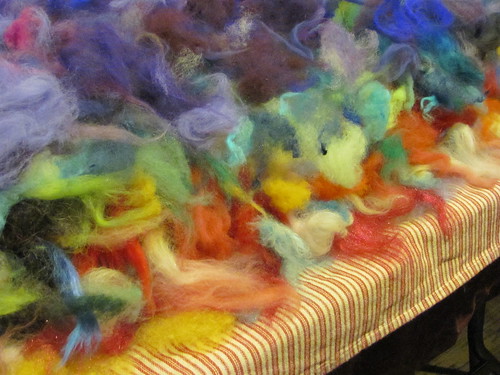
As in other years, we layered fiber, rolled it up like a jelly roll, and cut/ripped it into sections for each of us to take home.

This year we began with the fibers we brought, and then layered Linda's offerings in rainbow order.


I love the way the striation shows at the edges:

This year Linda offered the use of her shop's wildcarder to run the results through in order to make a slightly smoother preparation than previous years. She has challenged us to spin and knit socks with this year's fiber, so a smoother preparations will be great for a less "novel" yarn appropriate for socks.

I made a lumpy singles last time, this year I may ply the yarn either with itself or with a solid like black. Most likely I won't know until I spin and knit some samples.

Thursday, July 16, 2009

3 Steps Forward, 2 Steps Back

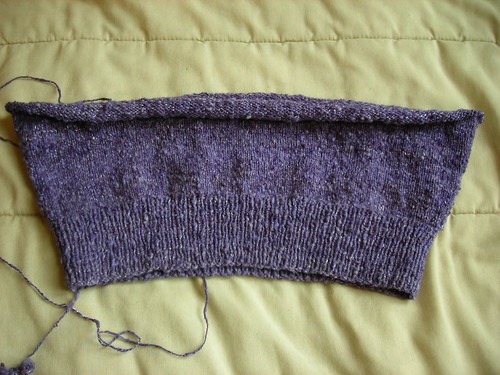
It's been very busy here at the opera, but I have had at least a little knitting time. I've finally finished spinning the purple yarn I've been making for as long as Rachel has known me (she so kindly pointed out this summer) and have started knitting it into a sweater set. I often make my own patterns, which certainly carries it's own satisfaction, especially for those of us picky about fit, but for this set I had planned to use a pattern I already own in a 1950 knitting pamphlet. I think I had intended to spin the yarn to match the gauge given in the pattern (not sure, as my intention dates to about 2006) but while all of the balls of yarn are fairly consistent* with each other, they are not, in fact, the right grist for this pattern. So I had to do a very small rewrite of the existing pattern to match my actual gauge. Still faster and easier than writing the whole pattern, right?

This is how far I got under that plan:


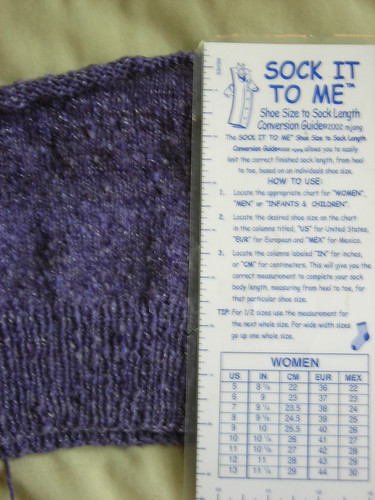
Knitting in the round affords lots of chances to try on a garment as it's being constructed, and correct errors well before the end. This was my try-0n point, the point at which I instantly regretted second guessing my original instinct to knit 5" of ribbing. The pattern (authentic 1950 you recall) only called for 3" of ribbing, and although I knew better, I deferred to the pattern at 3" because I was sick of knitting 1x1 rib. Also, the body increases were too close together and the body itself a bit looser than I had hoped for (or indeed than they appeared on the model).


So instead of keeping 8" of the wrong thing, finishing it and hating it forever, I ripped out 5" of body back to the original 3" of ribbing.

Discouraging to do, but from this point I knit the additional 2" of ribbing I should have started with, and reworked the body shape and size to something much more flattering. At this point I've rewritten the pattern extensively, almost equivalent to just writing my own in the first place. Almost. I'm still trying to mimic the look and shaping of the original, but fit my non-1950-model-body.


* As a point of fact, I am incredibly proud of how consistent my grist is on 2 1/2 pounds of fine yarn spun here and there over a 3 year period.