The wise are not wise because they make no mistakes. They are wise because they correct their mistakes as soon as they recognize them.
--from Xenocide, by Orson Scott Card
As a kid, school work came fairly easily to me. I could usually get a B on my first effort, which left me free to go outside and play. In high school I worked harder on the first effort and got A's, which left me free for drama club, odyssey of the mind, scholastic bowl, and other geeky fun. It wasn't until college, where there weren't grades, that I was expected to go back into a project and turn in a second draft, or sketch, or sewing sample. I was also expected to take risks and experiment. If done correctly, true risks and honest experiment lead to failure, or at least unexpected results, half the time or more. That means going back and trying again with new variables. At the time, I hated making mistakes. I saw them as failure. If I had done better or known better, I would have gotten it right the first time.
After college in my professional life I still hated mistakes. They felt like failure and I beat myself up over them. This is a tough attitude to live with in technical theater. In theater we experiment. We also adjust the work on our little part once we see how it fits into the whole. We get to a finished product in steps, and we definitely correct our errors. So every time I got to dress rehearsal and got "notes" on my work, listing all the little problems that needed to be fixed for the next night, or changes that would make the costumes look better under the lights, or help the performers wearing them, it felt like failure. If I was better at this I wouldn't get notes.
Luckily, I have come to understand mistakes better. They're not failures. They are part of a process, and only 1 step along the way. The best thing about mistakes is that they can be corrected. It has taken a long time, but I now take joy in identifying the mistakes so that I can correct them. I had to let go of the idea that a first attempt is the only attempt. It is the first step, and it's purpose is to give me everything I need to get to the second step. At work, I make things differently now, with the idea that each step is not being done to finish, but to put me at the best advantage for the second step. And in aiming for a good process rather than an immediate perfect result, and being ready for mistakes, I make fewer. Go figure.
I've been trying to teach my students this, while keeping in mind that I wasn't able to learn it yet when I was them. I definitely see myself in my honor students, for whom high school was easy. Unfortunately, school isn't life, and it turns out that being able to recognize and correct one's own mistakes has much more bearing on successful adult life than being really good at multiple choice test. That's been a real let down, let me tell you.
I knit this cardigan years ago, but thanks to weight gain and an accidental trip through the washing machine, it has gotten rather tight. It's a favorite, my first sweater where I started the process with dirty wool, and then washed, dyed, combed, spun, and knit. So I'm not going to give it up, even if the buttons do gap.
But boy does that look crappy--and it makes me look fat. My friend Becky had mentioned a knitting blog that went step by step through sewing grosgrain ribbon behind your button placket to keep it from gapping. You see this all the time in store bought cardigans, especially the vintage 50's ones. It finally clicked that I could go back and do this to a sweater even though it was already finished. And boy was it worth going back in and fixing that, even years later.
This is the inside of each button band--buttons on the right and holes on the left. I used a wide (about 7/8") grosgrain behind the buttons, then removed them and re-stitched them going all the way through the sweater and the grosgrain. I used 2 narrow bands (1/4-3/8") on the buttonhole side running down either side of the vertical buttonholes. Both were whipped in by hand and none of the stitching shows in front.
Much better! Whether you call it fixing a mistake, or taking the next step in a project, the improvement is well worth the time it took! At some point I'm going to go back into a number of my cardigans and do the same.
If you're not making mistakes, you're not trying hard enough!
--Miss Havisham in "The Well of Lost Plots" by Jasper Fford
This is a great overview of what we're doing at Glimmerglass at the moment. There's a quick shot of me cutting at my table, and of course lots of my co-workers are featured too. Only 8 days until the first opera opens--eeek!!!
Tuesday, May 17, 2011
One of the big parts of my job is making patterns for the costumes. The pattern making is what I get the most enjoyment out of, and find the most fulfilling. Of course, like most things in life, it's only about 10% of the work of making a costume, but luckily the work flows quickly, so I get to go back to pattern making once every 2 months or so.
While working on the dance concert over the past few months, it occurred to me that I had a really good illustration of the range of what pattern making is. I could get into details and try to explain the advantages/disadvantages of draping on a dress form vs. drafting using measurements and rulers, but that would bore you.
Instead I have pictures.
Even if you've never sewn before, it's probably pretty clear that this is the pattern for some kind of shirt. A simple tunic to be precise.
But this?
This is a dress. And to get a sense of scale, I should say that each of those 8 pieces is nearly as big as I am, and that in order to show the whole pattern I had to lay it out on the stage floor and then photograph it from up in the catwalks above the audience.
La Traviata is in it's final orchestra dress rehearsal tonight. Glimmerglass has a tradition of putting full sets, costumes, and lights on stage much earlier in the process than most opera or theatre companies would. The advantage of this is that the designers can continue to refine their work to a much higher level and designers and director can better take inspiration from each other's work and react to it. From a costume point of view it also gives us even more time to custom fit the costumes we make for the singers.
The disadvantage to this schedule for us in the shop is that we have about half the "standard" amount of time from the point at which we do a first mock-up fitting to the point when we need to put a wearable costume on stage. This year we did that in about a week and a half instead of the customary four weeks. So we find ourselves needing to make design and fit changes to garments we're still scrambling to finish. The challenge is to continue to work to Glimmerglass's high standards while making these deadlines.
One of the most time consuming costume details my team has created this summer is a skirt made of layers and layers of tulle, covered in tiers of tulle ruffles. (If you've forgotten, tulle is a soft net, most available in nylon.)
The numbers involved in this project (and remember they all translate to many hours of labor) are truly impressive. The inner layers which support the skirt include 8 layers of tulle, each of them 10 yards (30 feet) around. That took most of a 50 yard bolt of tulle. The ruffles are gathered onto a tulle base. In most fabrics a ruffle twice as long as the base to which it's sewn would look plenty full. Tulle has an amazing ability to gather, so a traditional 2:1 fullness looks less than skimpy. We ended up using a double layer of tulle for the ruffle, and gathering it 8:1 at the bottom, slightly less as the layers move up the skirt.
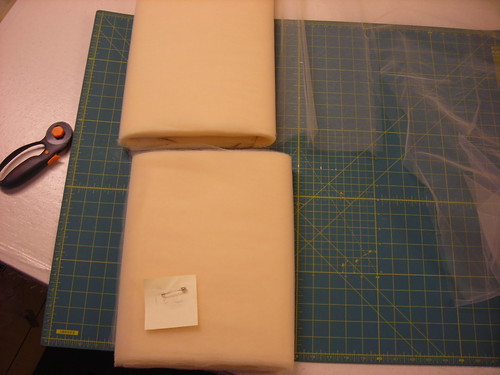
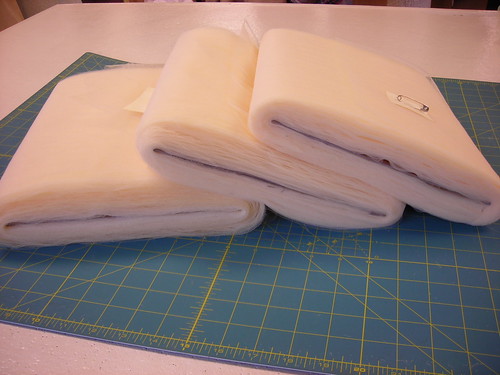
I cut the tiers by neatly wrapping the full yardage around a long cardboard card. Then I cut the correct tier depths through all the thicknesses with a rotary cutter. This probably saved hours of time over marking and cutting 13" from the bottom edge of 40 yards of net, then going back and doing it again for each of the rest of the 5 tiers.
The cardboard in the middle definitely made this process easier.
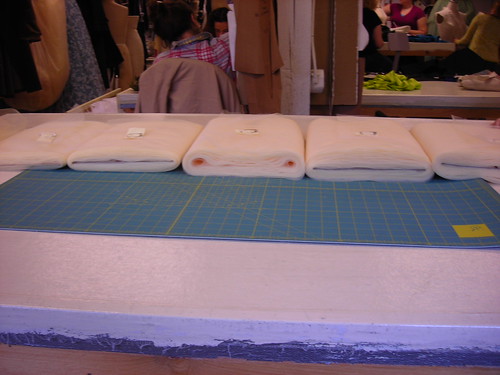
As mentioned, the tiers get fuller as they go down the skirt, which you can see by the varying thicknesses of the wound and cut net. The topmost ruffle is on the left, the bottom on the right.
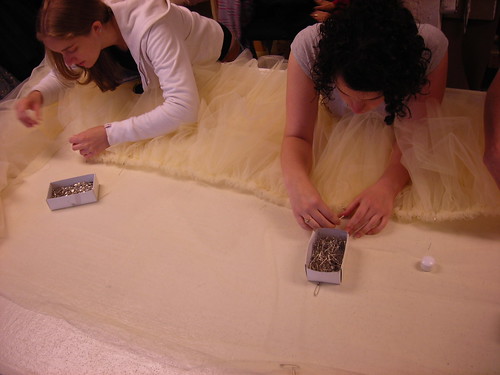
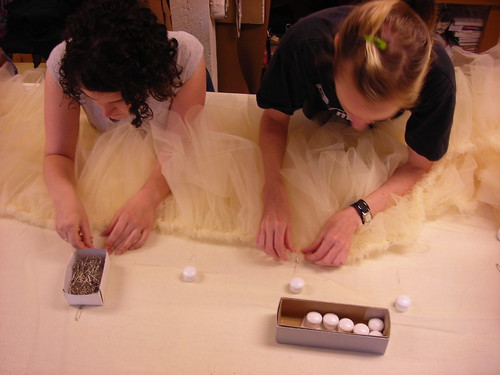
At least a half dozen costume technicians worked to gather, pin, and sew the tiers down to their base.
The finished skirt includes 220 yards of ruffle, all cut, gathered, and assembled in just a few days. That's on top of the 80 yards of tulle that hold the skirt out in its full shape. The hem underneath the bottom ruffle is held out to a circumference of over 3 yards by all of that tulle. I'm quite pleased with the final results, and my fantastic team!
The Republican party just spent $150,000.00 on new clothes for Sarah Palin. When it comes to politics and government, it's easy to let very large monetary figures wash over you. With a national debt in the tens of trillions of dollars, it can be difficult to remember just how large a sum $150,000.00 is.
On my way to work this morning I started calculating to try to put this kind of clothing budget into terms that intersect with my life and finances. After all, I make clothes for a living. The largest costume budgets I've come into contact with have been for operas. I don't handle the money or purchasing, so I don't usually know the exact budget of each opera on which I work, and I especially keep myself ignorant of the per yard cost of most fabrics before I cut them up. However, I do know that the costume budgets are generally in the tens of thousands of dollars. One of the first operas I worked on had a budget of $20,000.00 which the designer not only went over, but tripled. Even so, let's figure from $20,000.00 to $60,000.00 to costume an Opera. In all fairness, that budget does not include my or my crew's income, so add in between $9,000 and $13,000 for us. So an Opera could cost from $29,000.00 to 73,000.00.
Operas have a chorus. Sarah Palin does not. Operas are often opulent, chronicling the lives of the rich, or even of royalty. The Palins claim to be a down-to-earth household run by a hockey mom and a laborer. Operas are opulent. We are told that Alaska is not.
Somehow it costs two to five times as much to clothe Sarah Palin for the last few weeks of a campaign than it costs to create costumes for an entire Opera which will run for 2 months and be rented out in perpetuity.
Here's another point of view: how long does it take to earn $150,000.00? The median income in the US is a little over $40,000. At that income it would take almost 4 years to earn $150,000.00. More, if you'd like to still have that much after taxes. For me, I'd have to go back to the beginning of 2004 and continue to the end of this calendar year to have earned that much. To take home that much, probably back into 2001. I'm one of the few people who even save my tax information for that long.
Finally, what if I had donated to the Republican party? I don't donate to any politicians, and it would be a cold day in hell before I supported a Republican campaign, but lets just suppose for a moment that I had. My charitable donations usually range between $20 and $100. If I were to donate to a politician or political party, it would probably be in that range. I know that's a pittance compared to donations from corporations and wealthy individuals, but it would be a lot for me. If I donated, it would be to further the cause, to get the word out, to raise voter awareness of my candidate, to fund studies crucial to the campaign. It would not, in fact, be to buy clothes for someone who already has an income to buy their own clothes. In the face of $150,000.00 what would my donation even buy? Shoe laces? A pair of panties? Maybe socks? I mean, I can only guess that with at least 2 Operas worth of funding they're buying the most expensive clothes possible. They can't be spending it on more items than she'll wear before they become unfashionable next season.
If I were a republican donor, with McCain falling further behind in the poles, I'd be livid to see my money spent this way.
Of course, after being given the clothing, and wearing at least some of it, Ms. Palin has decided to say "no thanks" and go back to her old wardrobe. They claim she will not keep them but eventually donate the clothes to charity. I'm betting it gets overlooked and she keeps them. Just like she was able to keep and spend all the money she accepted for the "bridge to nowhere" to which she later said "no thanks." Maybe this is more of the same.
For that kind of money, every stitch of that clothing better be American union made.
Since Chris and Erica are always working on something, it seems like a good theme for Knitting with Fire would be to talk about current projects. We'll see where it goes.