Showing posts with label work. Show all posts

Tuesday, May 26, 2020

Missing Glimmerglass

"Even if I knew tomorrow the world would go to pieces, I would still plant my apple tree."
--attributed to Martin Luther

I first worked at the Glimmerglass Festival in the summer of 1999.  I had become disillusioned with the place I had worked for the previous two summers and was looking for a new summer home where the workers were valued as an asset, not used as cheap labor.  I found that at Glimmerglass, and have stayed there for every season since.

I would have started my 22nd season last week. 

My summer begins in December with hiring phone calls and seed orders. 

I've returned to the same company housing for most of my time at Glimmerglass, and have been lucky enough to garden there for nearly twice as long as I have had a home to garden the rest of the year.  I solidified my commitment to Glimmerglass the day that I planted asparagus there.

The paper tag identifies these as the seeds for Cooperstown.

And so, as I organize my seeds, place my orders, and plan my garden in the dead of winter, that planning always includes summer at Glimmerglass.  Springfield and Cooperstown have become a second home to me.  I have figuratively and literally put down roots there.

My ~10 week contract, starting right around our last frost date, favors plants that grow quickly from seed to maturity, and perennials that can take care of themselves for most of the year.  Below is a pot of a top-setting onion variety called "Egyptian walking onions" that I planted last fall.  They multiply by forming lots of small bulbs at the top of the greenery that drop down to the soil and "plant" themselves at a little distance from the mother plant.  Thus the "walking."  By bringing some of the top-sets indoors for the winter, I had a source of fresh scallions for cooking.  My plan was to then bring the pot to my summer housing (from here forward referred to as "the farmhouse") to plant now and let them multiply so I would have an onion supply that took care of itself and was ready to harvest from the day I arrived.

Egyptian walking onions, indoor onions about to leave the pot and joint their outdoor sblings.

Instead, I've planted the potted ones into the patch here at home.  I'll try a new batch next year to plant at the farmhouse.  I was happy for the winter supply of scallions, but it's clear that by spring the potted ones aren't as vigorous as those that stayed outdoors.  I am curious to see whether they "catch up."

My other experiment for farmhouse growing this year was with peas.  

Kevin Espiritu of Epic Gardening has grown climbing peas in a hanging basket to take advantage of his light situation--an area where there isn't enough light to grow veg at ground level,  but there is at eye level.

I borrowed his idea to take advantage of my seasonal situation.  I am home when it is time to plant peas, but at Glimmerglass when it is time to harvest and eat them.  I've tried starting seeds at home and transplanting them into the farmhouse garden, I've tried planting seed late at the farmhouse.  Neither was very successful.  So this year I planted at home, both in my garden and in a hanging basket for travel.  I've found an unexpected benefit...while something (probably deer) has eaten half of my garden pea plants, the basket is hanging out of reach and un-harmed.  Next spring I expect I'll be planting two baskets, one for my husband at home, and one to travel with me.

Snow peas and snap peas safe and sound above browsing height.

Like any good relationship, the plant exchange goes both ways.  I love having plants that carry memories of people and places dear to me.  I just transplanted asparagus from the bed my father planted 30 years ago to begin a patch at  home.  I've brought plants from home to Cooperstown, both to my housing and 
to the two gardens I was given permission to plant around the Glimmerglass costume shop.  I've also brought plants home to have a piece of Glimmerglass to enjoy for the rest of the year. 

Years ago we realized that there were iris leaves growing in a shade garden at the costume shop, but they had never flowered.  We transplanted them to the sunny side of the shop, and not only did they flower, but they have multiplied to the point where I had to thin them.  I spread the thinnings to other iris plantings around the Glimmerglass campus, and still had extras to give away and to bring home.  These pale purple iris bloom earlier than other colors.  They are always part of my first weeks at the Festival, but for now I am glad to enjoy them at home.

An iris transplated from the Glimmerglass costume shop to my home gardens in Wheatfield

Back in December, I prepared for Glimmerglass.  Even as a summer season looked less and less likely, I continued to plant and plan and nurture for an unsure future.  It's how I live in the world.  Using the present moment to plant and tend food and flowers for the (never guaranteed) future makes sense to me.

I miss my Glimmerglass family.  I miss the challenges of high quality professional work.  I miss working with my team, and spending days off with my closest friends.  In my loss, I also have opportunity.  I will finally see what blooms in my own garden in June.  I can experiment with container plantings that need too much watering to abandon for 10 weeks.  I spend time with my husband every single day.  

I can't visit my favorite summer places, but I can raise an Ommegang right here on my back porch, while I watch a father robin lead his fledgelings around the garden for the first time.


Next year in Coopertown, Glimmerglass family.


Friday, June 24, 2011

Working at the Festival

This is a great overview of what we're doing at Glimmerglass at the moment. There's a quick shot of me cutting at my table, and of course lots of my co-workers are featured too. Only 8 days until the first opera opens--eeek!!!

Tuesday, May 17, 2011

One of the big parts of my job is making patterns for the costumes. The pattern making is what I get the most enjoyment out of, and find the most fulfilling. Of course, like most things in life, it's only about 10% of the work of making a costume, but luckily the work flows quickly, so I get to go back to pattern making once every 2 months or so.

While working on the dance concert over the past few months, it occurred to me that I had a really good illustration of the range of what pattern making is. I could get into details and try to explain the advantages/disadvantages of draping on a dress form vs. drafting using measurements and rulers, but that would bore you.

Instead I have pictures.

simple costume pattern

Even if you've never sewn before, it's probably pretty clear that this is the pattern for some kind of shirt. A simple tunic to be precise.

But this?

complex costume pattern

This is a dress. And to get a sense of scale, I should say that each of those 8 pieces is nearly as big as I am, and that in order to show the whole pattern I had to lay it out on the stage floor and then photograph it from up in the catwalks above the audience.


Wednesday, July 21, 2010

Injured

I work with my hands. My work is delicate, requires great precision, and is often repetitive. Sometimes I spend all of a 12 hour day standing at my cutting table (well, all but lunch, dinner, and breaks). I have known other costume technicians who have gotten repetitive stress injuries like carpal tunnel or series back problems. I've always made an effort to pay attention to my posture when I work, to switch hands when I can, and to change tasks as much as possible throughout the day because I dread these injuries and the possibility that a serious one could take me away frommy work forever.

So what injury has kept me from typing for 2 months, seriously curtailed my work for a month, and *gasp* kept me from knitting?

Sitting at a damn desk.

I thought sitting down for spells in between the standing to pattern, cut, and teach would only benefit. Little did I know that after 17 years of making costumes it would be managing a shop and spending time at my desk creating class materials, doing committee work, and sending and replying to emails that would finally injure me.

It took the whole summer and lots of careful stretching, but I am fine now. I can knit again, and garden, and type or mouse on my laptop.

Then I went into school yesterday to begin prep for the coming year, sat at my desk for maybe a half hour to make sure all my files had been transferred to my new computer, and replied to maybe 3 emails, and pain shot up my arm.

I won't go back again without the new office chair Chris got for me. The adjust-ability should help as I've been using a straight back wooden chair at my desk for the last 2 years. The desk does not seem to adjust heights so I need to focus on adjusting the chair.

If anyone out there knows something about office ergonomics and what position I should be in at a desk, please send me a link!

Monday, April 26, 2010

This Is Why You Haven't Seen Me For the Last Two Weeks

I've been working overtime for the last two weeks getting the spring dance concert on it's feet. As you may remember, I make all the costumes for Buff State theater and dance productions. Much of this concert is designed by our faculty designer, but you'll see 2 student costume designers as well. There are over 20 students dancing in 7 pieces by 4 choreographers, and man is it fun! I mean, did you know Miles Davis recorded some funk in the 70's? I had no idea. If you're in the area please come see the show; it's well worth it! As you can see from the poster performances are this week, Wednesday through Saturday evening, with one matinee on Saturday. The ticket number is there along the side. Prices are really reasonable and there is a student rate (with proper i.d.)

Come see what I do all day!

Wednesday, October 07, 2009

Messing Up At Work

I am so glad that when I make a mistake at work it does not make the news. Here in Buffalo we’ve had 2 recent, very prominent work mistakes.

The first mistake was in one of the first Buffalo Bills football games of the season. I won’t even try to explain in detail, as my attempt to describe football plays is equivalent to the folks who see me spinning on my wheel at events and say to their children, “Look what she’s weaving,” or the people who explain the Devil’s Hole with, “gravity sticks you to the wall.” Instead, I will just say that it was the end of the game, the Bills were in the lead, and this player made a choice that allowed the opposing team to win. Most of the people I’ve heard talking about it believe that the choice he made was not what he was coached to do. Two local teenagers decided to express their dissatisfaction with his final play by vandalizing his lawn with a word that cannot be said on the radio.

This week, a prisoner briefly escaped from the holding center. Apparently he got out through a roof access hatch that was supposed to be locked. The guard who was responsible for locking it and checking it has been suspended.

Both incidents made the news for multiple days.

It seems to me that the football screw up was pretty minor—an error in judgement at the worst possible point in the game. No one was hurt, and he has been kind enough not to press charges against the lawn vandals. The jail screw up had huge repercussions, including a (thankfully) successful manhunt for an escaped prisoner who was deemed dangerous. Of course this one was a serious mistake, but honestly, I can’t count how many times I’ve left the iron on when leaving a costume shop at night, and I know I forgot to lock the door at least once. I wouldn’t even think of those things when trying to list ways that I’ve screwed up at my job. Thank goodness I’m not a prison guard.

My biggest mistakes in my job, as far as I can remember:

1. I accidentally shattered all the buttons down the front of a jacket with a hammer. Really, this was an accident, I was using a hammer and die on another kind of closure behind the buttons and didn’t notice until each and every one was in pieces.

2. I scraped an opera singer’s leg with a safety pin, drawing some blood. She was really gracious about it.

3. I cut the short wide man’s vest out of the fabric meant for the tall thin man’s vest. This one really sucked, because they were both intricately patterned fabrics, and not only had I taken the time to match the center fronts, facings, and pocket flaps when I cut the wrong one, but I had to figure out how to do it again with the scraps to cut the correct vest. I managed to fix it without having to declare what I had done wrong, or ask for more of the expensive fabric, but when I admitted to this months later, my co-workers told me that I had acted really squirrelly that day but they couldn’t figure out why.

4. I made my stitcher Larisa spend a full day beautifully pin-tucking the yoke of a Victorian nightgown, only to be reminded in the fitting by the designer that it was supposed to be made out of a piece of ready made lace fabric, no pin-tucking required.

5. In my very first costume shop internship, after declaring my great math skills, I miscalculated the length of fabric I needed to pleat and had to go back to the first hand and tell her it was too short. I thought it was the end of the world; she told me to figure out how much more was needed and make sure the seam was hidden behind a pleat.

6. I can’t even count how many times I have accidentally snipped a hole in a garment or myself.

7. My hands are covered in tiny scares, either from the aforementioned snips or from iron burns.

8. Neither can I count how many times I have bled on a costume.

9. In my first job, as a wardrobe mistress, I almost never got all the girls completely closed into their dresses during their quick change. In my defense, I was 17 and completely untrained. However, I am still complete crap at wardrobe.

10. Also in that first job, I put a rosary through the wash. If I was Catholic this would be a much bigger worry for me.

11. I flooded my shop and the downstairs hallway of the building it is in 3 times, thanks to a faulty washing machine. The first time was after 7pm on a Friday, and I had to call the after hours maintenance guys to come clean up after my mistake. It’s super embarrassing for your students to see you shop-vac-ing up a giant puddle you created. It’s also a lot harder to remain scary and intimidating to them after that.

12. I altered a suit coat in a crappy manner, and made it too tight.

13. I distracted and interrupted Wendy Wasserstein during the dress rehearsal of the first and only opera for which she wrote the libretto. When she turned towards me, and I realized my mistake, I blurted out "I'm sorry, I thought you were someone else," and scampered off into the dark again.

None of these made the news. None of them caused a death or an emergency, and only one resulted in injury. Many of them have led to really great learning experiences. I don’t think anyone I’ve worked with would disagree that I’m really good at reweaving holes in fabric. Most were made by moths or cigarettes, but a few were made by me.

I’m thankful every day that my mistakes at work are private, and most can be fixed with a seam ripper, new buttons, or a needle and thread. I can’t imagine what it’s like for surgeons, whose mistakes could end in a loss of life.

I’m also glad that my work mistakes aren’t open to the criticism of every arm chair quarterback in Buffalo. The last thing I need is a bunch of guys who can’t thread a needle discussion at length how I should have chosen a double dart instead of a single, or how the sleeve isn’t hung quite right.

Thursday, July 16, 2009

Sew A Mile In Our Shoes

La Traviata is in it's final orchestra dress rehearsal tonight. Glimmerglass has a tradition of putting full sets, costumes, and lights on stage much earlier in the process than most opera or theatre companies would. The advantage of this is that the designers can continue to refine their work to a much higher level and designers and director can better take inspiration from each other's work and react to it. From a costume point of view it also gives us even more time to custom fit the costumes we make for the singers.

The disadvantage to this schedule for us in the shop is that we have about half the "standard" amount of time from the point at which we do a first mock-up fitting to the point when we need to put a wearable costume on stage. This year we did that in about a week and a half instead of the customary four weeks. So we find ourselves needing to make design and fit changes to garments we're still scrambling to finish. The challenge is to continue to work to Glimmerglass's high standards while making these deadlines.

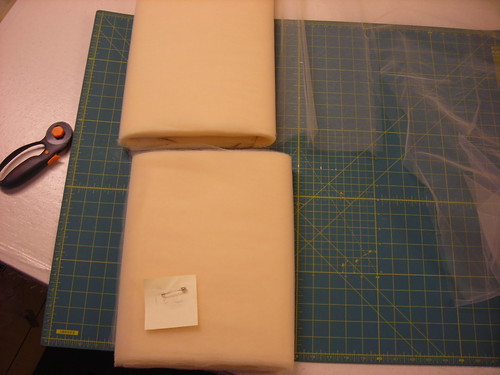
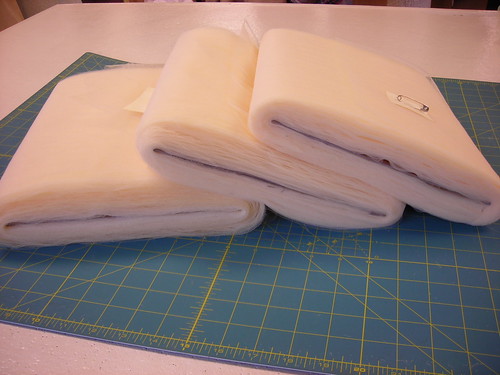
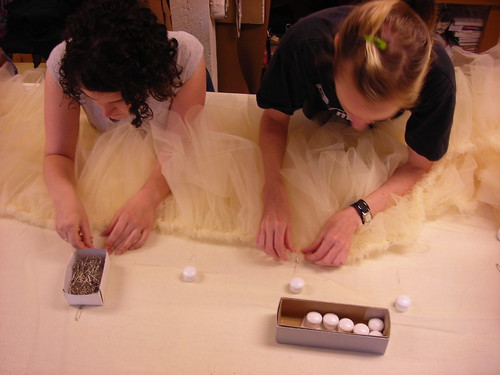
One of the most time consuming costume details my team has created this summer is a skirt made of layers and layers of tulle, covered in tiers of tulle ruffles. (If you've forgotten, tulle is a soft net, most available in nylon.)

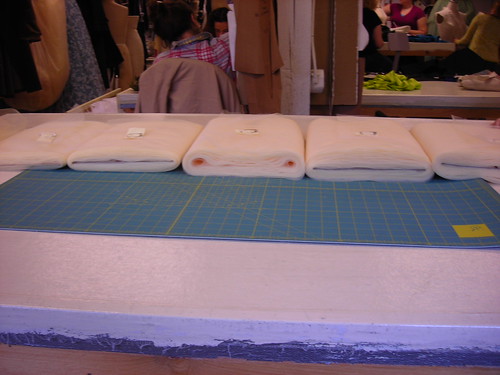
The numbers involved in this project (and remember they all translate to many hours of labor) are truly impressive. The inner layers which support the skirt include 8 layers of tulle, each of them 10 yards (30 feet) around. That took most of a 50 yard bolt of tulle. The ruffles are gathered onto a tulle base. In most fabrics a ruffle twice as long as the base to which it's sewn would look plenty full. Tulle has an amazing ability to gather, so a traditional 2:1 fullness looks less than skimpy. We ended up using a double layer of tulle for the ruffle, and gathering it 8:1 at the bottom, slightly less as the layers move up the skirt.


I cut the tiers by neatly wrapping the full yardage around a long cardboard card. Then I cut the correct tier depths through all the thicknesses with a rotary cutter. This probably saved hours of time over marking and cutting 13" from the bottom edge of 40 yards of net, then going back and doing it again for each of the rest of the 5 tiers.


The cardboard in the middle definitely made this process easier.


As mentioned, the tiers get fuller as they go down the skirt, which you can see by the varying thicknesses of the wound and cut net. The topmost ruffle is on the left, the bottom on the right.


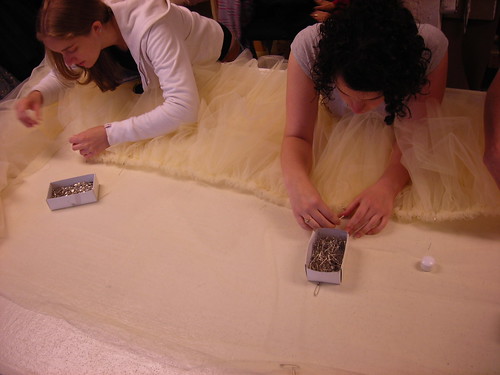
At least a half dozen costume technicians worked to gather, pin, and sew the tiers down to their base.


The finished skirt includes 220 yards of ruffle, all cut, gathered, and assembled in just a few days. That's on top of the 80 yards of tulle that hold the skirt out in its full shape. The hem underneath the bottom ruffle is held out to a circumference of over 3 yards by all of that tulle. I'm quite pleased with the final results, and my fantastic team!

Thursday, November 13, 2008

Why I Love My Work

The other day, I spent most of my work time online, first researching depression era feedsack dresses, and then at a motorcycle parts page, among other things. The best part is, I wasn't screwing around--that's what I was supposed to be doing! Both were research for "Grapes of Wrath" coming up in the fall. OK, so that explains feedsack dresses, but motorcycle parts? As you may recall, Rosasharn is pregnant throughout the book, so we'll need to make a pregnancy pad for the (hopefully not pregnant) student who plays that part. I like to use open cell air filter foam for padding, as it has a nice texture and memory, but more especially because it dries quickly after washing or sweating. The motorcycle place sells sheets of foam so that if you have a vintage bike you can't get new filters for, you can create one. I love the spirit of that all on it's own, and am giddy with the idea of further re purposing the foam for a pregger pad!

Monday, October 27, 2008

Priceless

I've always felt a little bad that I didn't choose an education and career path that could save the planet. I did well in Math and Science in high school, but decided instead to go into theatre. In fact, when I interviewed for admission into Boston University's theatre conservatory program, the 2 men interviewing me looked at my grades and test scores and asked why someone so intelligent wanted to go into theatre. To this day, I don't know whether or not they were serious. I chose to make costumes partially because of a small but growing talent for it, but also because it presented a challenge that I couldn't always solve on the first attempt, unlike most of my other academic subjects. It was probably the first time I didn't just choose the easy path. Eventually, I did go to a college where I could double major in theatre design and physics, but before anyone gets impressed, remember that it's a physics degree from art school!

The point being that, for the most part, making costumes will do very little for the environment. Even though I use all my pencils down to stubs, and tape my larger scraps of paper back together to make patterns out of, by and large what I do does create a small but significant bit of waste (if anyone has use for small fabric scraps, speak up! They're just filling landfills). We also use electric lights and equipment with a fair amount of energy draw and though I wish it were othersiese, all of that nice hydroelectric power from Niarara Falls gets sent all the way to New York City, while or power comes from coal, nuclear, and other nastiness that makes the city of Niagara Falls smell like acid rain.

I had all but given up on my work having any sort of positive environmental impact until just a few days ago. Now that I'm working at a college, it's important to me to cultivate some student stitchers, both to get the show done and because the whole point of college is learning, and this is what they can learn from me. In that interest I've gathered up the students who have expressed interest in learning about costumes and am teaching them how to sew. Some have a little sewing experience when they come to me, but I have 2 right now who had never picked up a needle before I showed them how to thread one, knot, and begin sewing. I set up one of these girls with a series of buttons to sew. After a few questions and approval of the first button sewn, I left her to them and returned to my work. After a little while she got a call on her cell phone. I heard her tell her friend that she was busy sewing buttons and then state, "I guess now when the button comes off one of my shirts I won't have to throw it out."

Score one for the planet!

Friday, August 08, 2008

Cherry Fever Stout

I enjoy freelancing. It’s great to have the chance to work in bigger cities that truly support the arts, or for bigger organizations with more enthusiastic support than is to be found in Buffalo. I love meeting other professionals from around the country, picking up ideas from other drapers, and making friends who are all over the country working in our small but spread out profession. When I got to the Shakespeare Theatre in DC, I realized that I had worked at the Santa Fe Opera at the same time as one of the other drapers at the Shakespeare. She just looked at me, and without batting an eyelash said, “Of course you did, because there are only six people who work in theatre.” It often feels that way, when I travel to a new city only to discover that I’m working with 5 people I’ve already worked with before.

The downside of freelancing is that, in the long term, it’s hard to feel like anyplace is home. For someone like me, who does have a home and more importantly a husband who is my real home, freelancing can start to wear me down. I’ve been gone for 5 months, and boy was it good to pull into the driveway and unload all my stuff for a good long time. (In case you're curious, “a good long time” is 9 months.)

There’s a lot of other little stuff I started to miss while freelancing, like easily available internet, my own bed, and my many hobbies, most of which don’t fit on a plane or are too much to pack in the truck. I was thrilled to pick up my spinning wheel half way through the journey, but at this point it’s been 7 ½ months since I’ve brewed a batch of beer. I had been planning to brew a German maibock in time for May, but Studio Arena closed just when I would have started it.

So after unloading the truck and kissing my husband hello, I cracked open a sweet stout from my last batch (Chris didn’t even make a dent in 5 gallons of beer over 5 months, so it was almost all still here waiting for me) and hit the books. I landed again on a recipe for a cherry stout, made some calls to locate frozen sour cherries at one of the local farm markets, and got to business.

I’ve had Belgian ales and lambics that included cherries, but not a stout. This is probably not the sort of thing anyone will be serving me anytime soon, so if I want it (and I do!) I’ll have to make it myself.


The cherries get added to the wort after the boil for long enough to pasteurize them, but the recipe (found in The Complete Joy of Homebrewing) cautions not to boil again with the cherries, or it will set the pectin and leave the beer with an unpleasant haze.

The last two falls, I’ve brewed a pumpkin ale, which calls for boiling with the pumpkin, but then removing it before the wort goes into the fermenter. This recipe ferments with the cherries for the first five days to make the most of their fermentable sugars. They won’t actually add any sweetness to the final beer, because all the sugar will be used in the fermentation and converted to CO2 and alcohol. They will add their amazing sour cherry flavor, but I have no clear idea about how the final brew will taste.


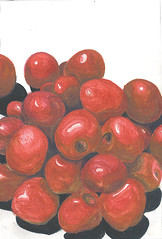
I was so excited about the cherries that I decided to feature them on the label. I often draw my labels while boiling the wort, but this one took a lot longer than that, probably longer than the actual brewing process. I hand draw my labels (as opposed to using photos or clip art or asking Chris to do it) because I like the look, but also because I never do any real drawings anymore, just quick working sketches, usually of sweaters on headless bodies. The labels keep me in practice. It’s not as much about keeping the skill sharp as about the kind of observation needed to draw something. Looking at something to draw it involves analysis, not of what it is, but of what it looks like, and HOW it looks that way. Not to look and let the brain say, "hey, that’s a round cherry," but to break down and reproduce the visual cues that the brain used to interpret that it’s round. I seldom look at things that way in any other part of life, because there’s no time and I rely on my brain’s interpretation skills to understand things quickly. Drawing something lets me slow down and look at that thing, live in the moment, and understand what I’m experiencing without short cuts or assumptions. It’s like (my limited understanding of) Buddhist mindfulness, or like the scene at the end of Our Town when Emily, after death, is given the chance to live one moment of her now finished life over again. This time she really experiences it and treasures it and pays attention and LIVES it. When she asks if anyone can ever go through life this way, she is told no not always, but sometimes poets and artists come close.

Here’s what that has to do with beer (and don’t even think that was off track):


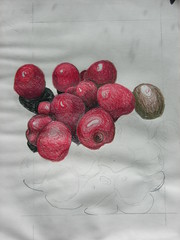
A fairly successful image of cherries. Because I was pleased, and loved the color theory involved, I also took a process picture to show the “underpainting” that I used to get the shadow colors. The cherry off to the right that looks like an olive shows only those colors, before I laid the red over the whole thing. I used water color pencils, so after drawing in the layers of color, I carefully painted over them with a wet brush to blend them and get a much richer color and more of a painted look.


This has been a good technique for me, as I’ve always been much more confident drawing than painting.

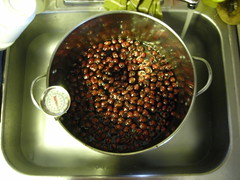
Right now the fermenting wort looks like this:


No, not a fashion statement. Ale yeast ferments best between 60 and 75 degrees F. It has been a bit over that in the apartment, but I didn’t want to wait until September to brew, so I’m using a trick I read in The Homebrewer’s Recipe Guide, which is to put a wet tee shirt over your fermenter so that the evaporating water will cool it. It’s working well, and has brought my wort temp down from 82 deg to 77.


Tuesday, August 05, 2008

Why 3?

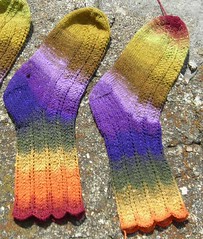
I love the colors in Noro yarn. especially the long fading repeats. Recently, I started seeing friends using Noro's sock yarn, which uses the same kind of long repeat, but weirdly provides three repeats in a ball. 3? Socks usually come in pairs, right? I get two size six socks out of 100 grams of sock yarn with a fair amount left over. Lots of folks get 2 pair out of 100 grams with little left over, and some can make it on 100 grams if they do a contrasting heal and toe. I don't see how 3 repeats in 100 grams helps any of us. Also, at $20 a ball I wasn't buying another just to get the pattern right. I figured each sock would take 1 1/4 to 1 1/2 repeats, so I sucked it up and knit the first sock, cut the yarn, and knit another the same size. This is what I got.Having been a first hand for 6 years, this drives me absolutely nuts. In a costume shop, the first hand assists the draper and is in charge of laying out and cutting the draper's clothing patterns. That means one of the few things that is solely the first hand's responsibility is pattern layout. Not just the dreaded matching of plaids that you read about in Judy Blume novels, but also matching florals, paisleys, etc and arranging bias stripes to chevron at seams or patterns to mirror themselves at center back and center front. That being said, a heavy stripe pattern being two inches off, like those two socks up there when worn next to each other, is way worse than if the two had nothing to do with eachother.

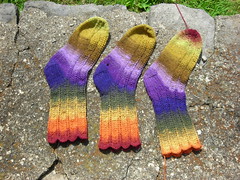
I couldn't take it, but weirdly enough, for my little feet each sock took slightly less than a full repeat, so I picked the placement I preferred (the second sock I knit, which is the one on the left in the picture) and I started from the same spot in the pattern repeat and knitted a third sock.
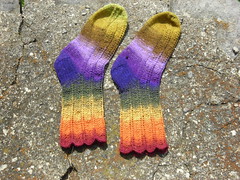
Now, if the aliens land on a rainy day and get a soaker on their way from their ship to my door, I can offer a trio of dry socks, helpful to any tri-pedal alien who wears a woman's size six. It felt weird to still be knitting the same pair of socks after I had already finished 2, but look how much better this pair looks:

Now I can wear them in front of my first hand without shame, and can still hear what Chris is saying to me while I'm wearing them. much better.

Monday, March 03, 2008

Ups and Downs

Here is one more article about the situation at Studio Arena. I am not holding my breath.

In more pleasant news, I am enjoying my time at the Shakespeare here in DC. It's interesting whenever I get to a new place, to think through the pros and cons of life there. Of course, no city or situation is perfect, or perfectly horrible, so it's interesting to figure out which aspects of it's particular life are pluses, and which are minuses, especially compared to my home, or where I last came from.

I came here without my truck, having been told that there is no parking. So far, I don't miss the truck at all (and Rusty can really use all the bunny litter in the back that I've been using for extra weight in the snow). I'm in temporary housing until Wednesday, so right now, I have a 15-20 minute metro ride to work. The metro ride has afforded me almost an extra hour of knitting time every day. I am about to start the toe of the sock I cast on a week ago on the plane! I may not have packed enough knitting--only 3 more projects after this one. So metro knitting, definitely a plus. Not having a digital camera here (I've been using Chris's or my scanner) is a downer. How will I post pictures of the finished socks?!?!

Also on the plus side, there is a knitting store down the street from my costume shop. Minus--after a week of unemployment, I still have 2 weeks before getting my first paycheck, so I have not even touched the door of said yarn shop and only slightly fogged up their window.

The down side of using the metro is that fare cards are not perfect. My fare card, still with $10 credit, decided to crap out, which meant mailing it away for an alleged replacement and buying yet another one with dwindling unemployment money.

Also on the negative side, on the flight out here, after getting through security with a ticket bearing the wrong name (there's a reason they give you that marriage certificate!) I managed to dump a hot cup of tea all down the left side of myself, and the right side of the guy next to me. He looked displeased. Luckily, his smaller tea spots were on sort of tea colored pants, and had dried invisibly by the time we landed. After being driven to my current housing, I walked to the metro and rode it to the shop (to be sure I could find my way) and while walking a bird shat all down the right side of my poor, tea covered cardigan.*

Finally, the item that is both positive and negative--I am currently in temporary housing. I will have to move on Wednesday. Bad--living out of suitcases and trying not to buy too much food. There will probably be no Internet where I am moving too, which makes communication and audio book downloading difficult. Good--the new place is reputed to have a washer and dryer and the new place is 3 blocks from work, so no more paying for the metro on weekdays. Of course, that could also be bad, as I'll lose the metro knitting time.

So let's review:

Good
extra knitting time on the metro
knitting store down the street
washer and dryer in apartment

moving closer to work
free museums
gainfully employed

Bad
paying extra for busted metro card
no camera to photograph knitting
spilled tea
bird shit
soon no internet

And really, in another month to month and a half, I'll have to add cherry blossoms to the good side. Too bad I don't have a camera so I can post the pictures. Maybe after that first paycheck...

*Did I mention it was a hand washed, hand dyed, hand combed, hand spun, hand knit cardigan? Thank goodness my little travel bottle of shampoo washed out all of it's Monday adventures.

Friday, February 29, 2008

In Our Nation's Capitol

I've tried to contact friends and family, but for anyone who does not yet know, I have shuffled off from Buffalo and am spending the next two months in Washington DC.

I'm here because I'm out of work. How did this happen? There have been lots of rumors flying, but the straight story is this, on Tuesday February 12, the board of directors of Studio Arena Theatre voted to cancel the remainder of the season. After their meeting, the entire staff were informed and given letters stating that we had been "indefinitely terminated."* My last day was that Friday, February 15th. Others were terminated on the 18th, so that they could finish running the current show and strike it. Shamefully, the board of directors did not announce the cancellation to the ticket holders or the general public until February 25th, 13 days (nearly 2 weeks) later. The poor box office staff were told that if anyone asked for tickets to one of the last 2 shows, they should make an excuse, like a computer error, for why they couldn't sell those tickets at the moment. The articles that the Buffalo News have printed about all of this have been spotty at best. The News staff does not include anyone with a theatre education or a clear knowledge of professional theatre, and of course the Board has kept them in the dark as much as possible. There is a very good article in playbill that I would encourage you to read. It gives the current situation and a fairly accurate description of any future possibilities.

I am, of course, incredibly upset, not just at losing my job, but also because my home town has lost its only professional theatre. Most of Buffalo didn't know that was a possibility until it was too late. No one even had a chance to help. Most of Buffalo also has not idea what a regional theatre is, or why the other semi-professional, non-LORT theatres in town are, in fact, not professional theatres, no matter how good their shows are.

With no other professional theatre in town, there is no other draping job in Buffalo, so after a week of unemployment I started a temporary job at The Shakespeare Theatre Company in Washington DC. Boy is it nice to be at a theatre that hasn't been failing for the past decade! I work in a spacious, well supplied shop with about 30 other people. We are building costumes for Julius Caesar and Antony and Cleopatra, which will be performed in rep on one of their two stages. Both productions will use the same stage, and any characters that occur in both plays will be played by the same actor. There area also a number of minor characters, like senators and soldiers, who will be seen in both, so that the two plays almost function as act I and II of the same play.

Also here at the Shakespeare Theatre (which does more than just Shakespeare) is Mary Zimmerman's Argonautica, which I saw last night. I feel incredibly lucky to have the chance to see this production in one of the few theatres in the country at which it's playing. This is the benefit of being at a healthy theatre in a healthy city. Not only was it a great play, but my friend Lisa was the scenic charge artist who painted this set when the show began it's run at Berkley Rep where she works. She has some great pictures in this blog post. And some more about making the set here.

Please do click on the links and look at the really cool pictures of this version of the famous Argonaut story. Here's a quick photo to pique your interest.


I miss Chris, Christopher, and Rusty terribly, but I am having a good time here, and trying to really appreciate everything this theatre has to offer. I plan to get out and do some letterboxing tomorrow, and on Sunday attend my first Reconciling in Christ* Lutheran Church and accompany a couple of coworkers to some of the many museums this town has to offer. Oh, and did I mention that not only do I already have 2 good friends in the costume shop but have worked with 2 others at other theatres, and my friend Tessa will also be coming up from Buffalo to join us!

*I find nothing "indefinite" about termination.

**an affiliation among Lutheran churches designating full welcome to gay members, guests and clergy

Sunday, December 16, 2007

Does This Make My Ass Look Big?

Now and then, I get paid to make someone look fat. Contrary to what a few actresses may claim, that is not normally my goal, but about once a year I make some sort of padding for a show. Earlier this year I built a Pan costume with padded out haunches, and last year I got to pad men to look like corseted Victorian women for The Mystery of Irma Vep. This time around we're doing a Christmas show by A. R. Gurny called Indian Blood. One actress plays 3 of the minor characters, one of whom is described as "a Polish woman of ample proportion." The play is set in the 1940's, so I set out with the intention of creating a different and larger body for her that would give the impression of a large woman wearing a fairly firm foundation garment.

The right side of the photo will give you some sense of the size and shape of the actress before padding.

I started with a muslin base fitted to the actress, and then built onto it with filter foam (used in AC, air purification systems, etc). Because the filter foam is very open, it will dry quickly after washing.
I try to form padding in sections, partially to best mimic how flesh sits on the body, and partially to allow the padding to move with the wearer's body--so that they don't just look like they've stuffed pillows down their shirt!
I covered the padding with another layer of muslin, so it's a simple unit, easy to clean and wear, with a zipper up the back. In most cases I would make this cover in spandex to be smooth and skin-like, but in this case I wanted a firm woven cover to mimic a hearty undergarment. We did add spandex sleeves with a little padding to add just a little waddle to her otherwise too thin arm.

Finally I draped the actually costume over the padding. They are two pieces for the sake of laundry, but go on as one for the sake of the dresser. The actress, by the way, was thrilled to wear it! So gratifying for us, as some actresses have been made so insecure by years of auditions and agents that they might refuse to go on stage in a fat pad, or insist that the program note that they are padded and not actually fat. Hooray for the secure actresses!

Thursday, October 11, 2007

A Bit About Work

We've been going through stock recently and I came back across this dress. It was built for the character Mrs. Alving in Ibsen's ghosts, and is based on various dresses and research from 1880. As I do for most period costumes I build for the stage, this one started with the appropriate undergarments.
The design is by Ann Emo. Look at those gorgeous fabrics and how they work together.
I did the patterning and fitting. Both of us researched the time period, Ann from a visual and cultural point of view, me from a pattern and structural point of view.

I'm very pleased with the results.

Monday, December 11, 2006

Pontius Pilate


Here he is in all his evil Roman glory: Pontius Pilate. Don't think that the crowd forced some nice civil servant into crucifying Christ, from all other accounts of him, Pilate was brutal, even by Roman standards. According to James Carroll in Constantine's Sword: the Church and the Jews, "Even by the standards of brutal Rome, Pilate seems to have been savage. When, six or so years after the death of Jesus, he wantonly slaughtered Samaritans for gathering to venerate Moses on a sacred mountain they associated with him, Pilate was recalled to Rome."

The puppet really captures that, don't you think? His chest is hollow behind his gold decoration, and he is without arms until the puppeteer's bare arm slithers out to snatch the pearl Artaban offers him to free Shamir. He's all draping fabric, gold decoration, and hollow framework.

(Ok, I don't know why blogger is refusing to display the entire picture, but if you click on it you should be able to see it full sized in another window. Sorry about that.)

Puppets!

I don't often talk about work when I'm not there. I figure most folks aren't really interested in the nuts and bolts and dull details of making costumes when they could get a couple of tickets and see the finished product on stage being worn by actors who are talking about something much more interesting. The show I just finished building before Thanksgiving is an exception to that rule because, well, puppets!

Each December almost every Regional Theatre in America does a Christmas or holiday show. When I lived in Rochester that meant six consecutive years of Christmas Carol. Thankfully, when I moved to Buffalo I was saved from Dickens. Studio Arena picks a new play each December, and in fact couldn't do Christmas Carol if it wanted to, because another theatre down the street already does Christmas Carol every year, and well, what city needs two? On the same block? There are other community theatres, etc, that also produce it, but they're miles away.

This year's Christmas offering is based on the teleplay of a TV movie produced in the eighties which was based on a short story written by Henry Van Dyke over 100 years ago. In fact, you can read what is apparently the entire short story on the internet at this website, so I won't go into a synopsis. Just go read it. I'll wait here.

Ok, if that was too long, the gist of it is that Artaban was to set out with the other wise men in search of the messiah, but fell behind because he stopped to help someone, and spends the next thirty three years searching for Jesus, but missing him and using the jewels he had intended to give him helping the other people he finds in need along the way.

The adaptation written for Studio Arena is very theatrical in presentation. The story of Artaban is being told by peddlers, apparently recent converts to Christianity (then called "the way") in 68 AD. They tell it secretly because by this time The Way is seen by Rome as separate from Judaism, which was marginally protected, and Nero has just blamed the early Christians for the fires that ravaged Rome. Yes, those fires, the ones he fiddled through.

Anyway, the peddlers have traveled along the silk road through India and back , and use theatrical traditions they picked up along the way, including shadow puppets and almost life sized bunraku style puppets. These puppets are controlled by one to four puppeteers who are also visible behind them. The puppets were designed and built by Michele Costa, an amazing local puppeteer who has brought puppet shows to schools as well as art galleries and the Buffalo Fringe Festival. She received a Henson Award a few years ago. If you look down the listings of awards that year, all the other recipients are from New York City or L.A. and then there's Michele's listing for Buffalo NY. Here work is totally amazing and worth catching next time you see her listed here. I hear that she has a website but I can't for the life of me find it. If anyone else can, please let me know so that I can post a link to it here.

On to the puppets!

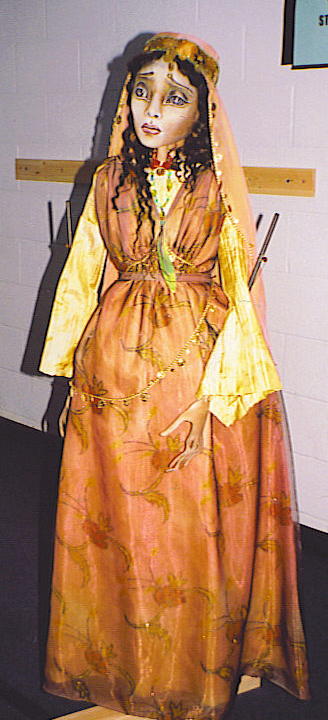
As I said, Michele designed and made all the puppets. My shop dressed the puppets, and built the costumes for the puppeteers and human actors in the rest of the show. These are some of the puppets whose costumes I draped.


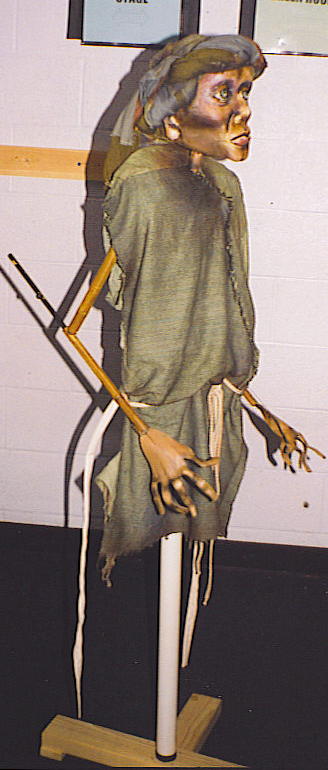
Shamir, who Artaban saves from slavery. Her head and both arms are controlled by puppeteers. You can see the sticks that move her forearms and hands sticking out the back of her sleeves.

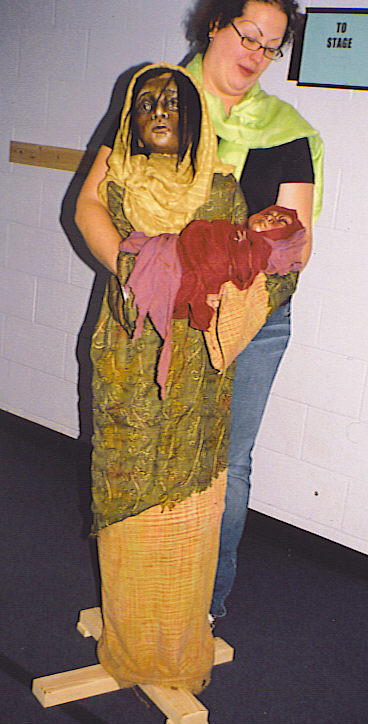
Ann and her baby, whom Artaban saves from the slaughtering of the innocents. My friend Tessa, who came in as a second first hand and ended up taking over for the second draper, is standing in for one of her puppeteers. In Ann's case the puppeteer's arms go through Ann's sleeves and the puppeteer's hands become Ann's hands. This is actually how most of the puppets are operated. The puppeteer who works Ann's right hand also operates the baby puppet, whose arms and head both move when he/she cries.


Tessa--I have magi photos for you!


Passhur is a blind man who can't be healed by Artaban ( a physician as well as magi) but comes back to Artaban after he has been healed by Jesus. This puppet has no legs because he is tied onto his puppeteer at the waist, so that the puppeteers legs become the puppet's legs.

Because blogger is consummately unhelpful, as I was deleting unwanted text, the photo of Pilate was also deleted, and apparently "undo" is a lie. Blogger has refused to reload the photo into this post, so the nasty Roman governor will have to have his own post. Also, I ran out of film before getting all of the puppets, and may post a few more after I get the next roll developed.

If you're in the area and want to see the show, it runs every day but Mondays through the 22nd. Check out Studio Arena's website for details.